

No products in the cart.
NLSAT 2027 Exam Date: Notification, Registration, Admit Card, Result & Full Schedule
In short: Everything NLSIU has confirmed about the NLSAT 2027 cycle, everything it has not, and what the 2026 schedule tells you about both, plus the selection rules that decide who actually gets one of the 120 seats.
Last updated: [[UPDATE THIS DATE EACH TIME YOU EDIT THE PAGE]]
Quick Answer
NLSIU Bengaluru conducts NLSAT once a year, and the NLSAT 2027 exam date is expected to fall on the last Sunday of April 2027 (Sunday, 25 April 2027), based on how the 2026 cycle ran. NLSIU has not released the official 2027 notification yet; when it does, registration is likely to open around November 2026 and close in late March 2027, with the result roughly three to four weeks after the paper. Every date below is updated the same day NLSIU announces it.
Key Takeaways
One exam, one shot a year.
NLSAT is the only route into NLSIU's 3-Year LL.B. (Hons.), with roughly 120 seats and no second attempt in the same cycle.
April is reliable; the notification month is not.
The paper has consistently landed in April, but the announcement has swung between November and February across cycles.
Part A screens, Part B selects.
Descriptive scripts are evaluated only for a shortlist, roughly five candidates per seat, so a good Part A gets your Part B read, and Part B decides the seat.
There is no published "cutoff mark".
NLSIU works on percentile thresholds and a stage-wise shortlist, not an advertised score. Any exact cutoff figure you see online is an estimate.
No legal background needed.
Part B supplies the principles; it tests how you reason with them, not what you have memorised.
NLSAT 2027 Exam Date and Full Schedule
Two columns. The left is the confirmed NLSAT 2026 schedule, the best available predictor of 2027. The right is the live cycle, updated as NLSIU announces each stage.
| Stage | NLSAT 2026 (confirmed) | NLSAT 2027 (official) |
|---|---|---|
| Admission notification released | Mid-November 2025 | Yet to be announced |
| Application portal opens | 15 November 2025 | Yet to be announced |
| Last date to apply | 23 March 2026 | Yet to be announced |
| Correction window | Announced separately, if opened | Yet to be announced |
| Admit card released | Approximately 7–10 days before the exam | Yet to be announced |
| NLSAT exam date | 26 April 2026 (Sunday), 10:00 AM – 12:30 PM | Expected 25 April 2027 (Sunday), awaiting confirmation |
| Provisional answer key (Part A) | Within a few weeks of the exam | Yet to be announced |
| Objection window | Short window after the key | Yet to be announced |
| Result declared | 20 May 2026 | Yet to be announced |
| Admission offers & verification | Late May – June 2026, in rounds | Yet to be announced |
| Proof of graduation deadline | By 31 December of the admission year | Yet to be announced |
| Academic session begins | 1 July 2026 | Yet to be announced |
Why we say “expected 25 April 2027”: NLSIU held NLSAT 2026 on the last Sunday of April, and a Sunday paper in the final week of April has been the pattern. 25 April is the last Sunday of April 2027. That is a projection from a consistent pattern, not an announcement. Do not book travel against it until the notification is out.
Is the NLSAT 2027 Notification Out Yet?
Not yet. As of the last update to this page, NLSIU has not published the NLSAT 2027 admission notification or opened the 2027 application portal.
Two practical consequences. First, there is nothing to apply to right now. Any site inviting you to “register for NLSAT 2027” through a form that is not hosted on nls.ac.in is not the official application. Second, the waiting period is not dead time: because the notification historically appears only four to five months before the paper, candidates who begin only after it lands are already behind on the half of the exam that takes longest to build.
How NLSAT Dates Have Moved Since 2022
NLSAT is a young exam. NLSIU launched the 3-Year LL.B. (Hons.) in 2022 and held the first NLSAT that year, so there is less history to read than for CLAT or CUET. Two patterns matter.
The exam month has been stable; the notification month has not. The paper has consistently landed in April. The front end has moved considerably: earlier cycles saw the notification closer to January and February, while the 2026 cycle opened registrations as early as 15 November 2025. That is a two-to-three month swing on the announcement against a fixed exam month.
The risk is asymmetric. Plan for an April exam and you will be right. Assume a January notification because it once happened, and you may miss a portal that opened in November. Treat April as reliable, and check the admissions page monthly from October onward.
The paper structure has held steady. Across cycles: 150 minutes, 150 marks, an objective Part A and a descriptive Part B of 75 marks each, roughly 120 seats. Preparation built for one cycle transfers cleanly to the next.
Where the Official NLSAT 2027 Date Is Published
- The admissions section of nls.ac.in, the notification PDF is the only source that counts. Everything else, this page included, reports it second-hand.
- The NLSAT applications portal, where your dashboard shows deadlines specific to your application. Reach it through the NLSIU admissions page rather than a search result, since the portal address has changed between cycles, and lookalike domains exist.
- Your registered email and SMS, once you have applied. This is why the number and email on your form must stay active until July.
If a date here ever disagrees with the notification, the notification wins. Write to admin@lawfren.com and we will correct it.
What Is NLSAT?
The National Law School Admission Test is the entrance examination NLSIU Bengaluru conducts for its 3-Year LL.B. (Hons.) programme. NLSIU is India’s oldest and most highly ranked national law university, and until 2022 it was known almost entirely for its 5-year integrated BA LL.B. The 3-year programme opened a second door: a route into NLSIU for graduates of any discipline who decided on law after finishing their first degree.
NLSAT is deliberately unlike most law entrances. It does not test legal knowledge, because it does not assume you have any. It tests whether you can read closely, reason from principles handed to you, follow what is happening in the world, and argue in writing under time pressure, the skills the LL.B. itself will demand. That is also why it suits engineers, doctors, journalists and commerce graduates as readily as anyone with a humanities background.
| Exam name | National Law School Admission Test (NLSAT) |
| Conducted by | NLSIU Bengaluru |
| Programme | 3-Year LL.B. (Hons.) |
| Introduced | 2022 |
| Frequency | Once a year |
| Mode | Offline, pen and paper |
| Duration & marks | 150 minutes, 150 marks |
| Approximate seats | 120 |
| Official website | nls.ac.in |
NLSAT 2027 Registration and Application Form
Registration for the 2027 cycle has not opened. When it does, the application is entirely online and takes 30 to 40 minutes if your documents are already scanned. Do not leave it to the final 48 hours. Portal load near a deadline is real, and a failed payment at 11 PM on the closing date has cost candidates a year.
Application fee
| Category | Fee (2026 cycle) |
|---|---|
| General / EWS | ₹2,500 (approx.) |
| SC / ST / OBC-NCL / PwD | ₹2,000 (approx.) |
| Payment mode | Online only, via card, net banking or UPI |
Fees are revised from time to time. Confirm the 2027 figure in the current notification before paying.
Step-by-step: how to fill the NLSAT application form
- Open the official portal. Go to nls.ac.in and find the NLSAT application link under Admissions. Reach it this way rather than through a search result, so you do not land on a lookalike site.
- Create an account with your name, email and mobile number, then verify both through the OTP sent to you. Use contact details that will stay active until July.
- Select the right programme. NLSIU runs one portal for several programmes: choose 3-Year LL.B. (Hons.). Candidates have lost a cycle by applying to the wrong course.
- Fill in personal and academic details exactly as they appear on your degree certificate and government ID. Spelling or date-of-birth mismatches cause trouble at verification.
- Enter your graduation marks. If your final semester result is awaited, use the appearing-candidate option and keep marksheets ready for later.
- Claim category or PwD status and upload the certificate in the prescribed format. Claims made after the deadline are not entertained.
- Upload your documents: photograph, signature, ID proof, educational certificates, and where required a CV and a bona fide certificate if you are still in your final year.
- Choose test city preferences in order, usually at least three. NLSAT is offline, so pick cities you can reach comfortably by the exam morning.
- Pay the fee online and keep the transaction reference.
- Review everything before submitting. Treat the submission as final.
- Download the confirmation page, filled form and payment receipt. Save PDFs and take a printout.
The correction window
NLSIU may or may not open an edit window in a given cycle, and when it does it is short and limited to specified fields, typically minor personal details rather than category claims or academic qualifications. Triple-check name spelling, date of birth, category, and your photograph and signature uploads before submitting, because those are the fields that create problems later.
Documents to Keep Ready Before You Start
Scanning these in advance turns a frustrating hour into a twenty-minute task:
- Passport-size photograph, in the dimensions and file size the portal specifies
- Scanned signature on white paper
- Class 10 certificate (commonly used as date-of-birth proof)
- Degree certificate, or latest marksheet if you are a final-year candidate
- All semester or year marksheets from your bachelor’s degree
- Government photo ID: Aadhaar, PAN, passport, driving licence or voter ID
- Curriculum vitae, where the application asks for one
- Bona fide certificate from your college, if you are in your final year
- Category certificate (SC, ST, OBC-NCL, EWS) in the prescribed format, if claiming reservation
- PwD certificate, if applicable
- A working card, UPI ID or net banking for the fee
NLSAT 2027 Eligibility Criteria
| Criterion | Requirement |
|---|---|
| Qualification | Bachelor’s degree in any discipline from a recognised Indian or foreign university |
| Minimum marks (General / EWS / OBC-NCL) | 45% aggregate |
| Minimum marks (SC / ST / PwD) | 40% aggregate |
| Final-year students | Eligible to apply; the offer stands only if the degree is completed with the required aggregate |
| Proof of graduation | To be submitted by 31 December of the admission year |
| Age limit | None |
| Prior legal study | Not required |
| Attempts | No stated limit |
International students
NLSIU runs a separate international-student route. Broadly, a candidate qualifies by being a citizen of a country other than India and having completed at least ten years of schooling or higher education outside India. Both conditions apply together; one alone is not enough. Confirm the current requirements and the separate application track in the notification.
Foreign degrees, percentage-to-CGPA conversion, NRI and supernumerary categories, and what counts as valid proof for appearing candidates are covered in depth on our NLSAT eligibility page.
NLSAT 2027 Admit Card
NLSIU releases the admit card on the applications portal roughly 7 to 10 days before the exam. It is not emailed as an attachment and not posted to you. You download it by logging in with the credentials created at registration. This is the practical reason to store that email and password somewhere you will still find them four months later.
Check the moment you download it: name spelling against your photo ID, photograph and signature, category if you claimed reservation, the full centre address rather than just the city, the reporting time (which is earlier than the exam start time), your roll number, and any instructions printed on the reverse.
If anything is wrong, contact the NLSIU admissions office immediately rather than turning up and hoping. Errors are usually fixable with a week’s notice and rarely fixable on exam morning. Print two copies and keep a photo on your phone as backup.
NLSAT Exam Centres
NLSIU publishes the list of test cities along with the notification, and you select your preferences, usually at least three, nearest first, while filling the application form. Your allotted centre appears on the admit card.
Recent cycles have run centres in cities across all regions. The list below is indicative of what has been offered before, not a confirmation for 2027:
| Region | Cities offered in recent cycles |
|---|---|
| North | Delhi, Chandigarh, Lucknow, Dehradun, Varanasi, Jammu |
| South | Bengaluru, Chennai, Hyderabad, Kochi, Vijayawada |
| East | Kolkata, Bhubaneswar, Patna, Guwahati, Ranchi |
| West | Mumbai, Ahmedabad, Jaipur, Nagpur |
| Central | Bhopal, Indore, Raipur |
Choose deliberately. You are picking where you will be at 10 AM on a Sunday in April, possibly after an overnight journey. A city you can reach the night before beats a marginally closer one that requires travelling on exam morning.
Exam Day: Reporting, What to Carry, Time Strategy
Carry: your printed admit card, the original photo ID matching the name on it, and the stationery NLSIU permits.
Leave behind: phones, smart watches, calculators and any electronic device. Centres typically have no storage facility, so bringing them creates a problem before you have written a word.
Reporting: reach well before the reporting time printed on the admit card, not the exam start time. They are different, and the gap covers verification and seating.
Time strategy: decide your Part A / Part B split before you begin rather than improvising. Roughly 60 to 70 minutes on Part A, protecting the remainder for the descriptive half, is a decision worth several marks on its own. Running short on Part B is the most common way a well-prepared candidate loses a seat.
NLSAT Exam Pattern
A single question paper in two parts, both compulsory, across 150 minutes.
| Section | Question type | Marks |
|---|---|---|
| Part A | 75 multiple-choice questions | 75 |
| Part B | Descriptive, legal reasoning answers plus essay | 75 |
| Total | N/A | 150 |
Part A: objective
Three content areas, each carrying equal weight: English comprehension (reading and interpreting written passages), current affairs (national and international developments), and critical reasoning (analysing arguments and drawing conclusions, including logical reasoning and legal aptitude). Each question carries one mark.
Part B: descriptive
Two components:
- Legal reasoning (60 marks). Five problem-based case studies, one answer each, in the region of 200 to 250 words, worth 12 marks apiece. You are given the legal principles; you are marked on how you apply them to the facts.
- Analytical ability, essay (15 marks). One essay of up to roughly 500 words, assessing your grasp of the issue, the coherence of your argument and the structure of your writing.
Marking Scheme
| Response | Part A | Part B |
|---|---|---|
| Correct answer | +1 | Marked on quality of reasoning |
| Incorrect answer | −0.25 | No negative marking |
| Unattempted | See the note below | Zero |
Important: check this in the current notification
Some NLSAT notifications have specified a deduction for unattempted Part A questions as well as wrong ones. If that rule applies in your cycle, leaving questions blank carries the same cost as answering them wrongly, which changes your attempt strategy completely. There is no defensive value in skipping. This is unusual enough that it is worth reading the marking paragraph of the notification word for word rather than relying on any summary, including this one.
NLSAT Syllabus, Subject-Wise
Part A
| Subject | Questions | Marks |
|---|---|---|
| English comprehension | 25 | 25 |
| Current affairs | 25 | 25 |
| Critical reasoning | 25 | 25 |
| Total | 75 | 75 |
Part B
| Component | Questions | Marks |
|---|---|---|
| Legal aptitude & reasoning | 5 (12 marks each) | 60 |
| Analytical ability (essay) | 1 | 15 |
| Total | 6 | 75 |
A full topic breakdown, question types and past-paper analysis are on our NLSAT syllabus page.
NLSAT Selection Process: How the 120 Seats Are Actually Filled
This is the part most candidates never read properly, and it changes how you should prepare. Selection runs in three stages.
Stage 1: Part A screening
A rank list is prepared from Part A performance alone. To stay in contention you must score above zero in Part A. Part A’s job at this stage is not to win you a seat. It is to get your descriptive answers looked at.
Stage 2: Part B evaluation, in a 1:5 ratio
Part B scripts are evaluated only for a shortlist drawn from the Part A ranking, in a ratio of roughly five candidates per available seat. With about 120 seats, that means the descriptive answers of only a few hundred candidates are read at all. Everyone else’s Part B, however well written, is never marked.
Stage 3: final merit list
A fresh rank list is prepared on the combined Part A and Part B score, and offers are made from it, subject to two conditions:
- Non-zero in both parts. You must score above zero in Part A and above zero in Part B.
- Percentile threshold. General and EWS candidates must be above the 75th percentile of eligible candidates on the aggregate score; SC, ST, OBC-NCL and PwD candidates must be above the 40th percentile.
What this means for your preparation. Part A is a gate, not a scoreboard. Clearing it comfortably is necessary, but no amount of extra Part A accuracy substitutes for Part B once you are inside the shortlist. And because your final rank is the combined score, a strong Part A still counts in Stage 3. The practical reading: get Part A safely into shortlist territory, then spend your remaining preparation time almost entirely on descriptive writing, because that is where the differentiation between the shortlisted few hundred actually happens.
Answer Key and Objections
NLSIU publishes a provisional answer key for the objective Part A after the exam, followed by a short window to raise objections against specific questions. There is no equivalent for Part B, since descriptive answers are evaluated by examiners, so there is nothing to cross-check against a key.
If you intend to object, note the question number and your reasoning on exam day while it is fresh, and follow the format and any fee the notification specifies. Objections without supporting justification are generally not entertained.
NLSAT 2027 Result and Scorecard
Results follow roughly three to four weeks after the exam. In the 2026 cycle the paper was held on 26 April and the result was declared on 20 May, a useful benchmark for 2027.
You access the result by logging into the applications portal with your application number and password. The scorecard typically shows sectional and total marks and your All-India rank. Save a PDF copy immediately, since portals do not stay open indefinitely, and you will need the scorecard at the admission stage.
NLSAT Cutoff and Percentile Rules
NLSIU does not publish a cutoff mark
Admission runs on stage-wise shortlisting and percentile thresholds, not an advertised score. Any specific cutoff figure you see online, including on this page, is an estimate.
Here is something worth being clear about, because a lot of what circulates online gets it wrong: NLSIU does not publish a “cutoff marks” figure. There is no official number to clear. What exists instead is the stage-wise shortlisting described above, plus the percentile thresholds: above the 75th percentile for General and EWS candidates, above the 40th for SC, ST, OBC-NCL and PwD candidates, calculated on the aggregate score of eligible candidates.
Every “expected NLSAT cutoff” number you find, including estimates in the mid-90s out of 150 for the General category, is exactly that: an estimate reverse-engineered from reported scores and selections. They are useful as a target zone. They are not a pass mark, they are not published by NLSIU, and they shift each year with paper difficulty and the size of the applicant pool.
For scale: thousands of graduates compete for roughly 120 seats each cycle, putting the overall selection rate in low single digits, and lower still for General category candidates from outside Karnataka. That is not meant to discourage you. It is meant to correct a common miscalculation. Candidates who budget eight weeks are pricing NLSAT as a formality, and it is not one.
Year-wise trends, category-wise analysis and safe-score discussion are on our NLSAT cutoff page.
Admission, Document Verification and Session Start
Selection does not end at the result. Once ranks are out, NLSIU issues admission offers in rounds, and candidates must complete document verification and pay the programme fee within each round’s deadline. Missing a round deadline can forfeit a seat your rank had already earned.
Keep originals and attested copies of everything you uploaded ready before the result date, not after. Final-year candidates should note that this is where proof of the completed qualifying degree becomes non-negotiable, and the offer is provisional until that is submitted, with a deadline of 31 December of the admission year. In the 2026 cycle, the academic session began on 1 July.
Other 3-Year LL.B. Entrances Worth Tracking
NLSAT is one seat pool of about 120. Applying only to NLSIU stakes a year on a single result, and the smarter play for most graduates is to sit several 3-year LL.B. entrances in the same season, since the aptitude sections overlap enough that most preparation transfers.
| Exam | University | Format note |
|---|---|---|
| NLSAT | NLSIU Bengaluru | Objective + descriptive, April |
| NAIET | NLU Odisha | Fully objective, 120 MCQs in 2 hours, no negative marking |
| CNLU-ET | CNLU Patna | Objective |
| DET | DSNLU Visakhapatnam | Objective |
| SNLU entrance | HNLU / SNLU | Objective |
| MHCET Law (3-year) | Maharashtra CET Cell | Objective, state-level |
| CUET PG (Law) | NTA | Objective, multi-university |
| SLS AIAT | Symbiosis Law School | Objective, private |
Each conducting body publishes its own notification and schedule. A full comparison of eligibility, patterns and which combinations make sense together is in our 3-year LL.B. entrance exams guide.
Once the NLSAT 2027 Dates Are Announced: A Working Timeline
The first week after the notification drops
Read the notification PDF end to end, not a summary of it, especially the marking paragraph. Register early rather than on the last day. Put the exam date, application deadline and admit card date into your calendar with alerts a week ahead of each. Then take one full-length mock, cold, before studying anything. A diagnostic score is more useful than a comfortable one.
Five to six months out
Build the base. Read one national daily every day and keep a single running current affairs note rather than five scattered ones. Work through comprehension and critical reasoning sets steadily. On Part B, start with structure before style: how to open, how to state a principle, how to apply it to facts, how to close. Write two answers a week and have them read by someone who can tell you what is missing.
Three to four months out
Shift to timed practice. Sectional tests for Part A twice a week; a full mock every fortnight. Begin essay practice on themes NLSIU has favoured: constitutional questions, technology and society, gender, federalism, criminal justice. Keep every essay you write.
Two months out
Full-length mocks weekly, at the real exam time of 10:00 AM, on paper, with a timer. Analyse each mock for longer than you took to write it. Track two numbers: Part A accuracy after negative marking, and how many Part B answers you finished properly rather than trailing off.
The final month
Stop adding new material. Revise current affairs notes twice. Rewrite three or four of your weakest Part B answers from scratch. Download the admit card on release day and check every detail. Find the centre on a map and work out the route.
The final week and exam day
Two light mocks, no more. Shift your sleep so you are properly awake by 8 AM. Keep admit card, photo ID and permitted stationery in one folder the night before. Reach the centre before the reporting time, and go in with your Part A / Part B split already decided.
How to Prepare for NLSAT
- Learn the paper before you learn the syllabus. Read past papers first. They tell you what the questions actually look like, which no summary can.
- Treat current affairs as a daily habit, not a subject. One newspaper, one running note, every day. Cramming three months of news in the final fortnight does not work for a 25-mark section.
- Write, then get the writing read. Part B improves only with feedback, because you cannot see your own gaps. You read what you meant to write.
- Mock under real conditions. Same start time, on paper, uninterrupted, with a timer. A mock taken comfortably at midnight teaches you very little about a 10 AM paper.
- Analyse longer than you attempt. The value of a mock is in the review, not the score.
- Rehearse your time split. Decide the Part A / Part B allocation in advance and practise holding to it. Improvising on the day is how candidates run out of time on the half that decides selection.
Free Resources and Past Papers
You should not have to pay to find out what the exam looks like. Official NLSAT past papers and NLSIU sample papers are the single most useful free resource available, because they show the real question style rather than a coaching institute’s approximation of it.
- NLSAT Self Prep (nlsat.in): free notes, sample papers and mocks, the resource site Lawfren grew out of
- YouTube (@LawfrenCo): full lectures, past-paper analysis and answer-writing sessions
- Telegram community: date announcements are posted there first, plus daily guidance
Why Structured NLSAT Coaching Helps
Self-study handles Part A perfectly well. The difficulty is Part B, for the reason given above: you cannot grade your own descriptive answers. That is the one thing a graduate preparing alone genuinely cannot solve, and given the 1:5 evaluation ratio, it is the half that separates the shortlisted few hundred from the 120 who get in.
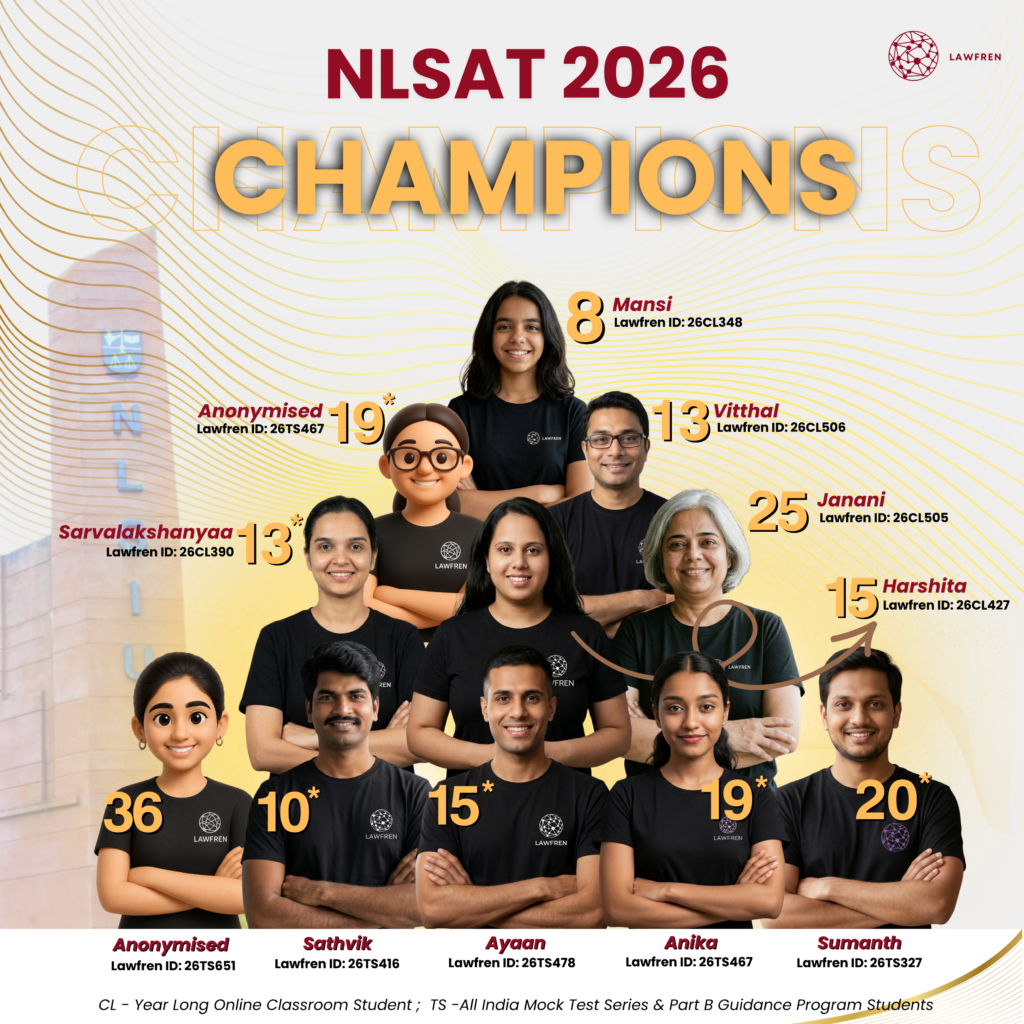
Lawfren grew out of NLSAT Self Prep, a free resource started in 2023 by NLU students and alumni after the first NLSAT in 2022, and became Lawfren in 2025. In the first batch, roughly one in two students got into an NLU. Since then: 6,000+ registered users, 2,000+ students taught, and 100+ selections across two years, including 20+ at NLSIU through NLSAT, 25+ at NLUO through NAIET, 30+ through CUET PG, 10+ each at MHCET and CNLU-ET, 5+ each at DSNLU and SLS AIAT. Recent NLSAT ranks include AIR 3, 8, 10, 13, 15, 19, 20, 25 and 36, and two of those toppers, Aparajitha K (AIR 10) and Gauri Bapat (AIR 15), now mentor the batches.
- NLSAT Comprehensive Batch: weekend live classes by NLSIU mentors, 25+ AIR-ranked full mocks and 40+ sectional tests, 200+ practice sheets, handbooks and e-books, one-on-one mentorship, and audio and video review of your Part B answers.
- Lawfren Elite: the same discipline across eight 3-year LL.B. entrances with roughly 110 CBT mocks, for candidates who want more than one shot in a season.
Explore NLSAT Coaching
Weekend live classes, AIR-ranked mocks and Part B mentorship from NLSIU rankers.
Try the Mocks Portal
Practice on the same CBT platform Lawfren students use to prepare.
Date-Related Mistakes That Cost Candidates a Year
- Waiting for the notification to start studying. If it lands in February for an April exam, that is eight or nine weeks, not enough to build Part B from zero.
- Assuming the notification month repeats. It has already swung from January to February to mid-November between cycles.
- Applying on the last day. Portal load, a failed payment or a rejected upload at 11 PM is not a story you want.
- Skipping the marking paragraph. If unattempted questions carry a penalty in your cycle, a cautious attempt strategy quietly costs you marks.
- Choosing a test city casually. You are picking where you will be at 10 AM on a Sunday in April.
- Ignoring the admit card until the night before. Name mismatches need days to fix, not hours.
- Applying only to NLSAT. One exam, 120 seats, one result. Several entrances in a season cost little extra preparation.
- Trusting a coaching site over the notification. Including this one. Verify on nls.ac.in.
In Summary
- NLSAT 2027 dates are not yet announced; the paper is expected on Sunday, 25 April 2027 based on the 2026 pattern.
- The exam month has been consistently April, but the notification has appeared anywhere between November and February. Check nls.ac.in monthly from October.
- Selection is a three-stage process: Part A screens, Part B is evaluated for roughly five candidates per seat, and the final rank uses the combined score subject to percentile thresholds.
- There is no published cutoff mark. Percentile thresholds and shortlisting ratios are what actually govern admission.
- Four to six months is a realistic runway, and most of it should go to descriptive writing with feedback.
NLSAT Resources
Frequently Asked Questions
NLSIU has not officially announced it. Based on the 2026 cycle, the paper is expected on the last Sunday of April 2027 (Sunday, 25 April 2027). The confirmed date will come from the official notification and will appear in the schedule table above the same day.
Not as of the last update to this page. It is published in the admissions section of nls.ac.in ahead of each cycle. In 2026 it appeared in mid-November alongside the opening of registrations; in earlier cycles it came closer to January or February.
Not yet announced. For reference, the 2026 cycle opened on 15 November 2025 and closed on 23 March 2026, a window of a little over four months.
In the 2026 cycle, 10:00 AM to 12:30 PM, for a paper of 150 minutes. The timing printed on your admit card is the one that applies on the day.
No. It is held once a year for admission to the 3-Year LL.B. (Hons.). There is no second attempt in the same cycle.
Offline. A pen-and-paper test at designated centres across India, which is why your test-city preference matters at the application stage.
Roughly 7 to 10 days before the exam, on the applications portal. You download it yourself after logging in; it is not emailed or posted.
About three to four weeks after the exam. In 2026 the paper was on 26 April and the result came on 20 May.
In the 2026 cycle, approximately ₹2,500 for General and EWS candidates and ₹2,000 for SC, ST, OBC-NCL and PwD candidates, payable online. Confirm the 2027 figure in the notification.
Yes. The admission offer stands only if you complete the degree with the required aggregate: 45% for General, EWS and OBC-NCL, 40% for SC, ST and PwD.
By 31 December of the admission year. Until then an offer to a final-year candidate is provisional.
Approximately 120.
NLSIU does not publish a cutoff marks figure. Admission is governed by stage-wise shortlisting and percentile thresholds: above the 75th percentile for General and EWS candidates, above the 40th for SC, ST, OBC-NCL and PwD candidates. Any specific cutoff number you see online is an estimate.
No. Part B scripts are evaluated only for a shortlist drawn from Part A performance, at roughly five candidates per available seat. Everyone else’s descriptive answers are never marked.
Yes, in Part A: 0.25 is deducted per wrong answer. Part B has no negative marking. Read the marking paragraph of the current notification carefully, as some cycles have also specified a deduction for unattempted Part A questions, which changes attempt strategy entirely.
No. NLSAT assumes no prior legal study. Part B supplies the principles and judges how you reason with them.
English comprehension, current affairs, and critical reasoning, 25 questions and 25 marks each.
The five legal-reasoning answers run in the region of 200 to 250 words each at 12 marks apiece, and the essay up to roughly 500 words for 15 marks. Confirm word limits in the current notification.
Your printed admit card, the original photo ID matching the name on it, and permitted stationery. Leave phones, smart watches and electronic devices behind, since centres usually have no storage.
Contact the NLSIU admissions office as soon as you spot it. Errors are usually fixable with a week’s notice and rarely on exam morning.
NLSIU may or may not open one, and when it does it is short and limited to specified fields. Treat your submission as final.
At centres in cities across India. You choose preferences, usually at least three, nearest first, in the application form, and your allotted centre appears on the admit card.
Yes, through a separate route. Broadly, you must be a citizen of a country other than India and have completed at least ten years of education outside India. Both conditions apply together.
Four to six months of consistent work is a comfortable runway, mainly because Part B writing improves slowly and only with feedback.
No. The notification historically arrives four to five months before the paper, and the descriptive half takes longer than that to build from scratch. April has been consistent, and that alone is enough to plan against.
Yes, and most serious candidates do. NAIET, CNLU-ET, DET, MHCET, CUET PG and SLS AIAT run on separate schedules, and their aptitude sections overlap enough that most preparation transfers.
The admissions section of nls.ac.in, and your dashboard on the applications portal once registered. Everything else, including this page, is secondary reporting.
This page is updated the same day NLSIU publishes anything, and announcements go out first to the Lawfren Telegram community. Checking the NLSIU admissions page monthly from October is the safest habit.
On This Page
- Quick Answer
- Key Takeaways
- NLSAT 2027 Exam Date and Full Schedule
- Is the NLSAT 2027 Notification Out Yet?
- How NLSAT Dates Have Moved Since 2022
- Where the Official NLSAT 2027 Date Is Published
- What Is NLSAT?
- NLSAT 2027 Registration and Application Form
- Documents to Keep Ready Before You Start
- NLSAT 2027 Eligibility Criteria
- NLSAT 2027 Admit Card
- NLSAT Exam Centres
- Exam Day: Reporting, What to Carry, Time Strategy
- NLSAT Exam Pattern
- Marking Scheme
- NLSAT Syllabus, Subject-Wise
- NLSAT Selection Process: How the 120 Seats Are Actually Filled
- Answer Key and Objections
- NLSAT 2027 Result and Scorecard
- NLSAT Cutoff and Percentile Rules
- Admission, Document Verification and Session Start
- Other 3-Year LL.B. Entrances Worth Tracking
- Once the NLSAT 2027 Dates Are Announced: A Working Timeline
- How to Prepare for NLSAT
- Free Resources and Past Papers
- Why Structured NLSAT Coaching Helps
- Date-Related Mistakes That Cost Candidates a Year
- In Summary
- NLSAT Resources
- Frequently Asked Questions
Quick Facts
About the Reviewer
Reviewed by Krishna Nair, NLSAT Mentor. Krishna a graduate of NLU and now mentors Part B answer-writing at Lawfren. Replace this with whichever mentor you want credited, and add their photo in the image widget on the left.
Questions about the 2027 cycle? Call or WhatsApp +91 8618274496, write to admin@lawfren.com, or join the Lawfren Telegram group at t.me/nlsatselfprep, where date announcements are posted first.
6,000+
Registered Users
2,000+
Students Taught
100+
Selections in 2 Years
AIR 3–36
Recent NLSAT Ranks