

No products in the cart.
NLSAT 2027
NLSAT 2027: Everything You Need to Know (Syllabus, PYQs, Resources, Exam Date, & Cut-offs)
The NLSAT (National Law School Admission Test) is the entrance exam for NLSIU Bengaluru’s 3-year LL.B. (Hons) program. Launched in 2022, it admits roughly 120 students each year. NLSAT 2027 will test candidates’ aptitude through two sections (objective MCQs and subjective writing) over 150 minutes. In contrast to CLAT, no prior law education is assumed the focus is on English comprehension, reasoning, and current affairs. Passing NLSAT (with the required percentile) is the sole gateway to NLSIU’s 3-year LLB program.
Table of Contents
- 1 NLSAT 2027 Important Dates & Tentative Schedule
- 2 Eligibility Criteria
- 3 NLSAT 2027 Exam Pattern & Syllabus
- 4 NLSAT 2027 Syllabus Details
- 5 NLSAT 2027 Cut-off and Selection Criteria
- 6 NLSAT Previous Year Question Papers (2022–2026)
- 7 NLSAT Sample Papers by NLSIU
- 8 NLSAT 2027 Preparation Resources
- 9 Lawfren’s NLSAT Success Stories
- 10 Frequently Asked Questions (FAQs)
NLSAT 2027 Important Dates & Tentative Schedule
NLSIU typically releases the 3-year LLB admission notification around mid-November, with applications due by late March and the exam in late April. For example, the 2026 cycle opened on Nov 15, 2025 and held the NLSAT on April 26, 2026. NLSAT 2027 dates are yet to be announced, but candidates should watch the NLSIU website and reliable coaching portals for updates. A tentative schedule (subject to official updates) is:
| Event | NLSAT 2026 | NLSAT 2027 (Tentative) |
|---|---|---|
| Admission Notification | Nov 14, 2025 | Nov 2026 (TBA) |
| Application Portal Opens | Nov 15, 2025 | Nov 2026 (TBA) |
| Last Date to Apply | Mar 30, 2026 | Dec 2026 (TBA) |
| Exam Date & Time | Apr 26, 2026 (10:00–12:30) | Apr 2027 (TBA) |
| Admit Card Release | Apr 19, 2026 | Apr 2027 (TBA) |
| Result & Rank List | May 21, 2026 | May 2027 (TBA) |
Dates above are based on last year’s NLSIU schedule; official NLSAT 2027 dates will be released by NLSIU.
Eligibility Criteria
Applicants must have a Bachelor’s degree (any discipline) from a recognized university. General category graduates need at least 45% aggregate, while SC/ST/OBC-NCL/PwD candidates need 40%. Final-year students may also apply, but their admission will be provisional until passing the degree by the deadline (proof of degree by Dec 31, 2027). International students must meet similar educational standards along with nationality requirements (details in NLSIU notices).
NLSAT 2027 Exam Pattern & Syllabus
The NLSAT paper is offline (pen-and-paper) and lasts 150 minutes. It is divided into Part A (Objective MCQs) and Part B (Subjective written answers), each worth 75 marks (total 150). Key features are:
- Part A – Objective (75 MCQs): Comprised of three sections (25 questions each) – English Comprehension, Current Affairs/GK, and Critical/Logical Reasoning (including basic legal aptitude). Each MCQ carries 1 mark, and there is a 0.25-point penalty for every wrong or unanswered question. In practice, Part A is a screening filter: generally only candidates with very high Part A scores (often in the high 70s out of 75) have their Part B evaluated.
- Part B – Descriptive (5 short + 1 essay): This section tests legal reasoning and analytical writing. It contains 5 short-answer problems (based on legal scenarios or logic) and 1 essay on a current affairs or general issue. Each short question requires about 200–300 words (no legal study needed) and carries 12 marks (total 60), and the essay (500 words) carries 15 marks, for 75 marks total. No negative marking applies in Part B. Clarity, structure and argumentative quality are key for Part B answers.
The table below summarizes the NLSAT structure:
| Section | Questions | Marks per Q | Total Marks | Negative Marking |
|---|---|---|---|---|
| Part A (Objective) | 75 MCQs (25 each on Comprehension, Current Affairs, Critical Reasoning) | 1 mark | 75 | –0.25 for each wrong/unanswered |
| Part B (Short Answer) | 5 descriptive problems (legal-reasoning) | 12 marks | 60 | None |
| Part B (Essay) | 1 essay (up to 500 words) | 15 marks | 15 | None |
| Total (Both Parts) | 81 | – | 150 | – |
NLSAT 2027 Syllabus Details
Preparing effectively for the NLSAT requires moving away from rote memorization and focusing instead on developing advanced comprehension, critical reasoning, and structured writing skills.
Part A Topics
- English Comprehension: Passages (around 500 words) with questions on main idea, inference, vocabulary, grammar, etc. (25 Qs).
- Current Affairs & General Knowledge: Questions on recent national/international events, history, politics, sports, economy, arts/culture, etc. (25 Qs).
- Critical/Logical Reasoning (including Legal Aptitude): Analytical reasoning puzzles (e.g. arrangements, assumptions), basic legal concepts and maxims, syllogisms or short arguments (25 Qs). No prior law knowledge is needed – candidates solve problems using logic.
| Competency Area | Primary Focus & Assessment Focus | Core Topics to Master |
| English Comprehension (25 Marks) | Evaluates the ability to read, interpret, and draw logical conclusions from complex academic texts. | Contextual vocabulary, sentence correction, tone analysis, identifying the central thesis, grammar, and inference. |
| Current Affairs (25 Marks) | Assesses awareness of key national and international events, focusing on their socio-political and legal significance. | Constitutional law amendments, landmark judicial rulings, international treaties, economic policy, and governance. |
| Critical Reasoning (25 Marks) | Tests logical agility and analytical problem-solving skills under time constraints. | Logical fallacies, strengthening/weakening arguments, assumptions, conclusions, logical puzzles, and seating arrangements |
Part B Topics
- Legal Reasoning Problems: 5 short questions based on fact-scenarios. Each requires a clear 200–300 word answer testing reasoning ability. These are often framed as legal-issue puzzles or argument-based questions.
- Essay: One essay question (choose any 1 topic among 3 options) on a contemporary issue (political, social, or related to law/current affairs). Answer in up to 500 words, using coherent arguments and an IRAC/structured approach. Prior legal study is not required; essays are judged on insight and expression.
| Subjective Segment | Primary Competency Evaluated | Key Structuring Rules |
|---|---|---|
| Legal Aptitude & Reasoning (60 Marks) | Tests the ability to apply clear legal principles to hypothetical sets of facts to determine liability. | Must write concise, logic-driven responses (150–200 words) applying the rule-to-fact (IRAC) method. |
| Analytical Ability Essay (15 Marks) | Evaluates the ability to construct a balanced, coherent, and evidence-based argument on a major contemporary issue. | Maximum 500 words; requires an introduction, supporting arguments, counter-perspectives, and a balanced conclusion |
NLSAT 2027 Cut-off and Selection Criteria
Admission depends on a two-stage selection. First, only candidates above a Part A cutoff advance to Part B evaluation (roughly 5 times the number of seats). Then final offers are based on the combined score (Part A + Part B), subject to category percentiles. Typically, General/EWS applicants must clear the 75th percentile in the aggregate, while SC/ST/OBC-NCL/PwD need the 40th percentile.
In practice, NLSAT is extremely competitive. The General category cutoff in 2026 was reported around 95.5 out of 150. Historical trends suggest aiming 90+ marks overall is wise for General aspirants. For a safe margin, target a near-perfect Part A (high 70s/75) to ensure you clear the first stage, and a combined score in the 90–100 range. (For reference, past analyses estimate final cutoffs: ~83/150 for 2022, ~89/150 for 2023, ~91/150 for 2024, ~93/150 for 2025 and ~94/150 for 2026) SC/ST/OBC candidates will have lower raw-score requirements due to relaxed percentiles.
| Admission Category | NLSAT 2023 | NLSAT 2024 | NLSAT 2025 | NLSAT 2026 | Predicted NLSAT 2027 Cutoff Range |
|---|---|---|---|---|---|
| General (Outside Karnataka) | 89 to 91 Marks | 90 to 93 Marks | 92 to 96 Marks | 93 to 95.5 Marks | 98 to 102 Marks |
| General (Karnataka Domicile) | 82 to 84 Marks | 84 to 86 Marks | 91 to 94 Marks | 89 to 91 Marks | 93 to 96 Marks |
| Economically Weaker Section (EWS) | 80 to 83 Marks | 82 to 84 Marks | 87 Marks | 85.25 Marks | 86 to 90 Marks |
| OBC – Non-Creamy Layer (NCL) | 80 to 82 Marks | 82 to 84 Marks | 79 Marks | 85 to 87 Marks | 78 to 81 Marks |
| Scheduled Castes (SC) | 71 to 73 Marks | 72 to 74 Marks | 75 Marks | 74.5 Marks | 70 to 74 Marks |
| Scheduled Tribes (ST) | 68 to 70 Marks | 70 to 72 Marks | 73 Marks | 68 Marks | 66 to 70 Marks |
Reconstructing the 2025 Scorecard Benchmarks
A closer look at the 2025 scorecard data reveals the precise score distribution required to secure admission:
- Outside Karnataka General (Male): Part A Score: 52.5 | Part B Score: 43 | Total Score: 95.5
- Outside Karnataka General (Female): Part A Score: 51 | Part B Score: 41.75 | Total Score: 92.75
- Karnataka General (Male): Part A Score: 50 | Part B Score: 40 | Total Score: 90.00
- Karnataka General (Female): Part A Score: 50 | Part B Score: 38 | Total Score: 88.00
- Economically Weaker Section (EWS): Part A Score: 51.25 | Part B Score: 34 | Total Score: 85.25
- OBC – Non-Creamy Layer: Part A Score: 48.75 | Part B Score: 37 | Total Score: 85.75
- Scheduled Castes (SC): Part A Score: 42.5 | Part B Score: 32 | Total Score: 74.5
- Scheduled Tribes (ST): Part A Score: 40 | Part B Score: 28 | Total Score: 68.00
NLSAT Previous Year Question Papers (2022–2026)
One of the most effective ways to prepare for NLSAT 2027 is by solving NLSAT previous year question papers. These papers help you understand the exam pattern, identify frequently tested topics, improve time management, and develop the analytical and answer-writing skills required for both objective and descriptive sections. After completing each paper, evaluate your performance, review your mistakes, and work on improving your speed and accuracy.
For your convenience, we have compiled the official NLSAT Previous Year Question Papers from 2022 to NLSAT 2026 below. Download each paper and use it as part of your regular preparation schedule. We recommend attempting every paper in a timed environment before checking the answers or referring to any study material.
Official NLSAT PYQs Available:
Tip: After solving each NLSAT PYQ, compare your performance with the expected standard of the exam, revise the topics where you lost marks, and practice descriptive answers using the guidance available through Lawfren’s answer-writing resources and YouTube lectures. Consistently solving NLSAT PYQs is one of the fastest ways to improve your score and boost your chances of securing admission to NLSIU Bengaluru.
NLSAT Sample Papers by NLSIU
One of the best ways to understand the NLSAT exam pattern is by solving the official NLSAT Sample Papers released by NLSIU Bengaluru. These sample papers reflect the style, difficulty level, and expectations of the actual examination, making them an invaluable resource for every NLSAT 2027 aspirant. They help you become familiar with the structure of both the objective and descriptive sections, improve your time management, and build confidence before the exam. We recommend attempting each sample paper in a timed environment and reviewing your answers critically to identify areas for improvement.
Below, you can download all three official NLSAT Sample Papers released by NLSIU. Solve them before moving on to the previous year question papers to develop a strong understanding of the exam format and the standard expected by the university.
Official NLSAT Sample Papers Available:
Preparation Tip: Attempt all three official sample papers before solving the NLSAT Previous Year Question Papers (2022–2026). Once you complete each paper, compare your responses with the expected standard, refine your legal reasoning and answer-writing approach, and use Lawfren’s study materials and YouTube answer-writing sessions to strengthen your performance in both Part A and Part B.
NLSAT 2027 Preparation Resources
A well-rounded strategy is key. Below are some recommended resources and tips (including Lawfren’s offerings):
- Official Syllabus & Sample Papers: Start with the NLSIU brochure and sample questions to understand the format. NLSIU’s website (nls.ac.in) provides NLSAT Sample Questions and any released previous papers. Practicing these builds familiarity.
- Study Materials: Cover the Part A topics thoroughly (vocabulary, grammar, puzzles, reasoning) daily editorial pieces from The Hindu or The Indian Express, supplemented by CAT reading comprehension prep books by writers such as Arun Sharma, Willey’s GMAT, LSAT Critical Reasoning and keep abreast of current affairs (politics, economy, science, etc.). Lawfren offers comprehensive notes tailored to NLSAT 2027. These materials are structured using insights from top rankers and cover all core concepts without requiring external guides. For Current Affairs, Lawfren publishes a monthly NLSAT 2027 Current Affairs Magazine that focuses on the most probable exam topics. Notably, 21 of the 25 Current Affairs questions in NLSAT 2026 could be solved using the Lawfren Current Affairs Magazines.
- Mock Tests: Regular practice with full-length mocks is crucial. Lawfren’s exams portal provides 25 full-length All-India ranked mock tests and 40+ sectional tests that simulate the exam difficulty. Timed practice helps with speed and accuracy under pressure. Analyze each mock to identify weak areas. Redditors say 2 Part B Essay Topics in NLSAT 2026 were based based on themes of Lawfren Free AIMT Mocks available for everyone.
- Part B Practice: Hone your writing by practicing the IRAC (Issue-Rule-Application-Conclusion) method. Lawfren’s Part B Compendium offers 100+ model legal questions with answer outlines drafted by NLSAT toppers. There’s also a “Must-Prepare Essay Topics” booklet covering frequent themes with brainstorming cues. Reviewing these model answers teaches how top candidates structure their responses.
- Guidance & Coaching: The official Lawfren YouTube channel features free masterclasses, video analyses of past papers, and structured guides on writing high-scoring answers for Part B. Consider guided coaching for structure and doubt resolution. Lawfren’s courses include live classes on approach and strategy (for both Part A MCQs and Part B answers), and personalized feedback on answers. NLSIU Mentors (Students of NLSIU who have cracked the NLSAT exam themselves) provide 1-on-1 mentorship and doubt-clearing sessions to keep you on track.
- Comprehensive Preparation Batches: Programs such as Lawfren Elite 2027 and NLSAT Comprehensive Batch 1 provide complete, live instructional coverage of both Part A and Part B. These classes focus on the specific skills needed to master the actual exam
Overall, balance your preparation: sharpen fundamental skills (reading, reasoning) for Part A, and practice structured writing for Part B. Make use of quality resources like the NLSIU sample papers and Lawfren’s tailored materials (notes, mock tests, essays) to maximize your score.
Lawfren’s NLSAT Success Stories
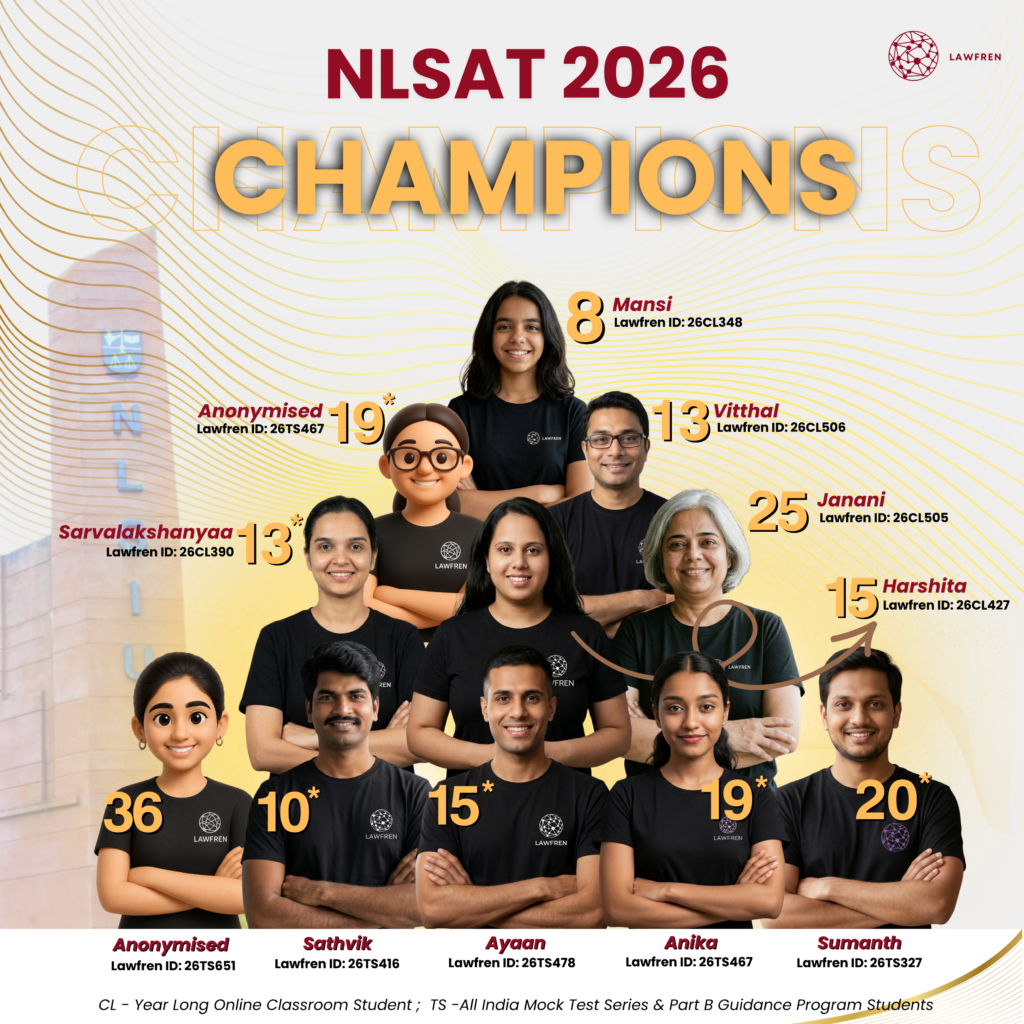
Lawfren’s track record speaks for itself. In the NLSAT 2026 exam, multiple Lawfren students secured top All-India ranks, reflecting the effectiveness of our targeted preparation strategy. Notable results from NLSAT 2026 include AIR 3, AIR 8 (Mansi), AIR 10 (Satvik), AIR 13 (Vitthal and Sarvalakshanya), AIR 15 (Harshita and Ayan), AIR 19 (Anika), AIR 20 (Sumant), AIR 25 (Janani and Anushka), and AIR 36 (Maitrayee). In NLSAT 2025, Lawfren students secured AIR 10 (Aparajita), AIR 25 (Roshan), AIR 36 (Nandini), AIR 69 (Sujit), AIR 72 (Anshu), and AIR 73 (Frenny). Earlier, in NLSAT 2024, Lawfren student Jay Shah secured AIR 5. Apart from these toppers, many other students have successfully secured admission to NLSIU by using Lawfren’s free resources and guidance on NLSAT Self Prep. Top instructors and mentors, all of them alumni of NLUs, guide students through every step, from foundational concepts to final mock exams.
In summary, NLSAT 2027 requires early planning and diligent practice. Stay updated on official announcements, master the syllabus with high-quality materials, and practice extensively with mock tests and model answers. With focused effort and support from Lawfren, you can confidently aim for admission to NLSIU’s prestigious LLB program.
Frequently Asked Questions (FAQs)
What is the academic eligibility criteria to write the NLSAT 2027?
To be eligible to write the NLSAT 2027, an applicant must hold a Bachelor’s degree in any discipline from a recognized national or international university. General, EWS, and OBC-NCL candidates must have graduated with an aggregate of at least 45% of total marks, while SC/ST and PwD applicants require a minimum aggregate of 40%. Students currently in the final year of their undergraduate degree are also fully eligible to apply, provided they submit proof of meeting the graduation requirements by the end of December of the admission year.
Does the NLSAT Part A really penalize unattempted questions?
Yes. Unlike most competitive exams, where unanswered questions do not affect the score, NLSAT deducts 0.25 marks for both incorrect answers and unattempted questions in Part A, according to the official guidelines. This design makes passive skipping as costly as choosing an incorrect answer, requiring candidates to use smart elimination techniques to minimize penalties.
Is prior legal knowledge required to perform well on the Part B Legal Reasoning section?
No. The official syllabus explicitly states that you do not need prior knowledge of law. Instead, NLSAT tests your logical thinking, analytical skills, and ability to apply a provided legal principle to a given set of facts in Part B.Evaluators look for clear, structured logic and a reasoned conclusion, rather than complex legal jargon or citations of specific statutes.
How does the dual-stage evaluation filter work on the exam day?
Although all candidates attempt both Part A and Part B during the single 150-minute exam session, their subjective Part B answers are evaluated only if they meet the Part A threshold. Specifically, candidates must score greater than zero in Part A, and their score must place them within the top tier of candidates selected at a strict 1:5 ratio per available seat. This means that only the top 600 scorers in Part A will have their Part B answer sheets evaluated.
How many seats are available at NLSIU Bengaluru for the 3-year LLB program?
NLSIU Bengaluru offers a total of 120 seats for its three-year LL.B. (Hons.) program. These seats are allocated across several vertical and horizontal reservation categories, which includes a 25% horizontal compartmentalized reservation for candidates from Karnataka
How should I structure my preparation to manage both parts of the exam effectively?
Successful preparation requires balancing critical reading skills with consistent writing practice. A recommended strategy is to dedicate five days a week to practicing Reading Comprehension and Critical Reasoning under timed conditions to master Part A. Alongside this, candidates should write at least two to three structured legal reasoning answers and one analytical essay weekly, using platforms like Lawfren to receive personalized feedback and refine their writing style.
What is the syllabus and structure of NLSAT 2027?
NLSAT 2027 will follow the same two-part format as previous years. Part A has 75 MCQs (25 English comprehension, 25 current affairs, 25 logical/legal reasoning), each worth 1 mark (–0.25 penalty for wrong/blank). Part B has 10 short-answer legal-reasoning questions and 1 essay (total 75 marks). Topics include reading comprehension, current events, puzzle logic, and general legal aptitude. No prior law study is needed; focus on reasoning and writing skills.
When will NLSAT 2027 be held and how do I apply?
NLSIU has not announced the exact dates for NLSAT 2027 yet. Based on past trends, NLSIU will likely release the notification in November 2026, open the application portal shortly thereafter, and conduct the examination in April 2027 (approximately 10:00 a.m. to 12:30 p.m.). Candidates should monitor the NLSIU admissions page and reputable coaching sites. Once announced, register and apply online via the NLSAT portal before the deadline. Admit cards are usually released a few weeks prior to the exam.
What resources can help me prepare effectively?
Start with NLSIU’s official syllabus and sample questions. Regularly read newspapers or Lawfren monthly current affairs summaries. Use dedicated test-prep resources like Lawfren’s NLSAT materials: they offer comprehensive live and recorded video lectures detailed notes (built from toppers’ insights), a monthly CA magazine, and extensive mock tests (via nlsat.in). Practice writing essays using Lawfren’s model questions and answers. If needed, enroll in a coaching program: Lawfren’s courses cover both Part A techniques and Part B writing strategy, with mentor feedback. Lastly, solve past papers and take timed mocks to build confidence and speed.